For 99% of the golfers out there, taking a vigorous wrist cock may be the answer to understanding the correct golf swing. When the club is taken back and extremely cocked, the twisted body is pulled further. This in turn turns a switch in the brain to pull the club with the body rather than starting the downswing with the hands. The feeling of the over cocked clubs leaves the mind hopelessly incapable of flipping the club back with the hands. It (the mind) orders the body to un-twist first and at the desired moment when it feels it has control of the club, let the hands do its work.
The technique is sound, however, considering my physique, it may be better to let the left wrist to act in concert with the right hand (middle two fingers holding the club) to accomplish this extreme twisting. Let the left wrist start the movement by flipping the club towards the left and around - the right hand taking over somewhere and cocking the club. The right arm movement bringing the club tightly to the top will force an upper body twist. At this point at the top, the upper body will automatically recoil and bring the club head towards the ball.
It is best to imagine and "see" the path of the club head through the ball so that the left hand can bring the club head back along the same path and the upper body can recoil back to the same path.
Friday, July 25, 2008


Tuesday, July 22, 2008
The delayed hit with the open and close technique
I have been wondering why an 11 year old kid can out-drive and out-score me in golf. The memorable thing is his picture taken at the tournament with his arms fully extended right after impact. It is not the muscles that is out driving me; it is the technique. My swing is still a hit from the top - as described by most of the books I read. But how do I do it? How do I develop a nice follow through like this kid has?
On a closer inspection of the techniques employed by the professionals, it is apparent that there is an open and closing of the hands at impact. In the driving range, in order for me to get the ball reasonably straight, I had to shift my weight first but purposely snap (open and close) at the ball with my hands. This, however, I concluded is difficult for me since it is an unnatural move for me. This is just not the way to go.
What I had to do is change my mental image of my swing. When I changed my mental image of the downswing to the left hand pulling the club to the ball, this created the natural open and close hit of Hogan. In order to accomplish this naturally, I had to change the swing techniques enumerated on the preceding posting. Instead of the right hand doing the flipping back of the club, it has to be my left shoulder pushing the left arm and club around and up while at the same time the left wrists flips or cocks the ball upwards to the top (in a very pronounced way). If the cocking of the club by the left wrist is strongly done, you can feel the club inertia actually pulling and tightening more the coiled upper body.
This movement brings the club up where it is ready to be pulled down towards the ball. As a matter of fact, you can feel when you are at the top that there is no other way to execute the "pulling" by the arms - except starting it with the shifting of the weight to the left and turning the body towards the ball and around to a C finish.
Let me repeat: The pulling of the hands is done by the transfer of the weight to the right. The result is an automatic weight shift, a delayed hit and a perfect finish.
On a closer inspection of the techniques employed by the professionals, it is apparent that there is an open and closing of the hands at impact. In the driving range, in order for me to get the ball reasonably straight, I had to shift my weight first but purposely snap (open and close) at the ball with my hands. This, however, I concluded is difficult for me since it is an unnatural move for me. This is just not the way to go.
What I had to do is change my mental image of my swing. When I changed my mental image of the downswing to the left hand pulling the club to the ball, this created the natural open and close hit of Hogan. In order to accomplish this naturally, I had to change the swing techniques enumerated on the preceding posting. Instead of the right hand doing the flipping back of the club, it has to be my left shoulder pushing the left arm and club around and up while at the same time the left wrists flips or cocks the ball upwards to the top (in a very pronounced way). If the cocking of the club by the left wrist is strongly done, you can feel the club inertia actually pulling and tightening more the coiled upper body.
This movement brings the club up where it is ready to be pulled down towards the ball. As a matter of fact, you can feel when you are at the top that there is no other way to execute the "pulling" by the arms - except starting it with the shifting of the weight to the left and turning the body towards the ball and around to a C finish.
Let me repeat: The pulling of the hands is done by the transfer of the weight to the right. The result is an automatic weight shift, a delayed hit and a perfect finish.
Friday, June 20, 2008
Working the flight of the ball
Now that the television networks can now show the ball tracking while in flight, it is now apparent that professionals do not "shoot straight." They actually work the ball left or right, intentionally and in every shot.
So from now on I will work my ball also. Usually, the common teaching to work the ball is to open or close the club face when addressing the ball. In my case, it works better if I turn my grip instead - weak or strong depending on what I want the ball to do.
Let me see if I update my previous posting.
ESSENTIALLY, THIS BACK SWING TECHNIQUE COMPLETES THE ESSENTIALS OF THE GOLF SWING.
So from now on I will work my ball also. Usually, the common teaching to work the ball is to open or close the club face when addressing the ball. In my case, it works better if I turn my grip instead - weak or strong depending on what I want the ball to do.
Let me see if I update my previous posting.
ESSENTIALLY, THIS BACK SWING TECHNIQUE COMPLETES THE ESSENTIALS OF THE GOLF SWING.
- Set-up: see other postings for stance, right knee warning, etc.
- Grip strong for a draw or weak for a fade.
- Backswing: Turn the head to the right like Nicklaus, look at the back of the ball, and push club head out with the left shoulder.
- Flick, as hard as possible, the club head along the ground and around towards the back as far as possible and feel the weight of the arms and club loading up the left shoulder.
- At the top, FURTHER TIGHTEN THE COILING MUSCLES by twisting the left shoulder until the club is felt at the top and ready for the unwinding motion.
- Downswing: Release the coiled body towards the ball and around to a great finish.
- NO ARMS INVOLVED IN THE HIT - JUST GRAVITY AND INERTIA EMPLOYED.
Friday, May 16, 2008
Tough Shit! Or the BASIC GOLF SWING!
I keep looking for that swing technique that I had found but lost - and I thought I found again. The reason it took a very hard time trying to remember what I did when I thought I had it - is because it is something that was unconsciously happening to my swing. Although I was trying to do something consciously, the result was excellent but it was not really what I was working on directly - that is why it was hard to remember - because it was something I was not really aware of that I was doing.
Any way, enough of the prologue, let us now reveal what I discovered without realizing it. What I was doing before was I was flicking the right wrist, alright, to the right, using the plane formed by the shaft - along the plane formed from the tip of the shaft to the gripped hands. What I did not realize then was I was flicking (with a reverse scoop motion the club head) - and here it is - ALL THE WAY TO THE TOP OF THE BACK SWING! There was no stopping and executing the upswing with the shoulders - like I mentioned before in my previous postings. It was one single motion to the top. The club head is flicked around the apron all the way to the top of the swing. From that position, the body pulls the club towards the ball and the hit.
What is so different with this swing is because the club is flicked all the way back, when the body comes around, the hit is so delayed, that you can sense that the shoulders have turned all the way around without effort - at the end of the swing! Remember, I was trying to force turning the shoulders? Well, this does it automatically - plus the "inside to outside" path of the club head is automatic.
There are four self checks that must be felt to ensure that the desired effect is remembered:
12/17/07: The preceding two paragraphs describe exactly my novel swing technique. However, to further assist in explaining the previous paragraphs and BUT ONLY IF THERE IS A CONFUSION ON THE EXPLANATION ABOVE, then read on. What is missing in the above paragraphs is the not-easily-noticed part of how the right hand (wrists) motion and the shoulder turn work together as one cohesive movement - each one doing its own independent job but both dependent on each other to accomplish the task of sending the ball on its way efficiently and accurately. In order to remember this technique, let us separately describe what each one is doing.
Any way, enough of the prologue, let us now reveal what I discovered without realizing it. What I was doing before was I was flicking the right wrist, alright, to the right, using the plane formed by the shaft - along the plane formed from the tip of the shaft to the gripped hands. What I did not realize then was I was flicking (with a reverse scoop motion the club head) - and here it is - ALL THE WAY TO THE TOP OF THE BACK SWING! There was no stopping and executing the upswing with the shoulders - like I mentioned before in my previous postings. It was one single motion to the top. The club head is flicked around the apron all the way to the top of the swing. From that position, the body pulls the club towards the ball and the hit.
What is so different with this swing is because the club is flicked all the way back, when the body comes around, the hit is so delayed, that you can sense that the shoulders have turned all the way around without effort - at the end of the swing! Remember, I was trying to force turning the shoulders? Well, this does it automatically - plus the "inside to outside" path of the club head is automatic.
There are four self checks that must be felt to ensure that the desired effect is remembered:
- This "inside to outside" effect should be a check to make sure the execution is correctly done.
- Also with the short irons, when doing the practice swing, I can feel how Anthony executes his delayed turnaround after the hit - I should be able to feel it this also (another check)!
- A third check (which is the needed effect) is the shoulders finishing completely turned around - pronouncedly more than just perpendicular to the target line.
- Another effect of this technique (the fourth check) is the ease of the execution of the upswing. There is no extra effort to be done. It feels like the whole swing is one complete and rhythmic motion, all fluidly bonded into one collective motion.
- Set-up: see other postings on grip, stance, right knee warning, etc.
- Backswing: Flip, as hard as possible, the club head along the ground and around towards the back as far as possible
- When the club head reaches the 5'oclock position, begin cocking the club up with the right hand.
- At the top, FURTHER TIGHTEN THE COILING MUSCLES by twisting the shoulders until the right biceps is pushed back against the side of the body or until the body is fully coiled.
- Downswing: Release the coiled body towards the ball and around to a great finish.
12/17/07: The preceding two paragraphs describe exactly my novel swing technique. However, to further assist in explaining the previous paragraphs and BUT ONLY IF THERE IS A CONFUSION ON THE EXPLANATION ABOVE, then read on. What is missing in the above paragraphs is the not-easily-noticed part of how the right hand (wrists) motion and the shoulder turn work together as one cohesive movement - each one doing its own independent job but both dependent on each other to accomplish the task of sending the ball on its way efficiently and accurately. In order to remember this technique, let us separately describe what each one is doing.
- First, imagine that each one is a flexible wheel. The wrists' wheel is parallel to the ground while the shoulders' wheel is perpendicular to the ground. Imagine the wrist or grip as the hub and the club head as the perimeter. The shoulders' wheel has the neck as the hub and the club head also as the perimeter.
- The wrists' wheel's ultimate goal is to turn the wheel (which is parallel to the ground) as much as possible clockwise to the right and, using its flexibility, to bounce back as hard as possible (towards the ball).
- The shoulders' wheel's main goal is the same - clockwise movement (but upwards since it is perpendicular to the ground) and as far as possible and bouncing back as hard as possible.
- Taken singly, it is difficult to execute (and awkward) but melding them together creates the effective golf swing, a movement, not up and down nor left to right and back, but along the golf plane and back as Hogan described.
- Why is this golf technique accurate? Because the wrists only opens like a door and slams like a door - no other movement.
- Why effective? You answer that. It is obvious once you have tried this technique.
Wednesday, April 02, 2008
CHIPPING basics
This is really the full swing technique but just to emphasize the importance of the right hand move I am classifying it as a chipping requirement. The reason is because it is very crucial to apply this instruction in chipping since it involves a mini swing and, therefore, errors are accentuated.
The right hand responsibility must only be to "apron-roll" the club head around and (clockwise in relation to the ground) towards the back - nothing else. It does not, it does not bring the club up. Bringing the club up is the responsibility of the torso (twisting upper body). The hit is also done by the unwinding torso.
Applying this technique to chipping results in creating the "slot" tantamount to the slot on the full swing. By the way, this also applies not only to the short game but to the full swing as well.
The right hand responsibility must only be to "apron-roll" the club head around and (clockwise in relation to the ground) towards the back - nothing else. It does not, it does not bring the club up. Bringing the club up is the responsibility of the torso (twisting upper body). The hit is also done by the unwinding torso.
Applying this technique to chipping results in creating the "slot" tantamount to the slot on the full swing. By the way, this also applies not only to the short game but to the full swing as well.
Sunday, October 28, 2007
Why the baseball bat technique works
22Sep2007: THE FINAL TEST IS THE HEAVY TRAINER CLUB. If the trainer club can be pulled by the body with an inside-outside effect of the club face, then it is correct. The real key is ending the coiled upswing at the top with the feeling of the clasped hands in the relative same position at setup. Only with this position will the trainer club be able to come back to the hitting zone with an inside to outside effect. By the way, even the right hand use is not necessary to get this effect. At address, if you would just imagine the plane as the same as the shaft and if you flick the club head around like an apron going backwards (with the right hand, with the left hand, or with both clasped hands) along that plane, then the shoulders will instinctively turn to bring it up - ending into a fluid motion at the top. It "should" end at the CORRECT position where the body can pull it down - the club coming back with and inside to outside path. But remember, the trainer club has to agree.
The above is the answer, using it as written in the previous posting makes the club go from in to outside on the downswing. Of course, with short irons the effect is more of going deeper (to the ground) than with the driver where the inside to outside swing effect is preferred.
The above is the answer, using it as written in the previous posting makes the club go from in to outside on the downswing. Of course, with short irons the effect is more of going deeper (to the ground) than with the driver where the inside to outside swing effect is preferred.
Monday, October 22, 2007
A Matter of Trust
All the previous postings talk about how to execute the ultimate swing. We have learned that reverse scooping is very important. In addition, we learned that the right hand V position must almost be a the 12:00 o'clock position to be able to correctly do the reverse scoop. Everything talk about being mentally in control about what is happening with the swing but is this really the way it should be? Can we keep mentally alert all the time in golf?
The answer is NO. But how does Tiger do it? The answer may be what he usually say to himself, "Trust your swing, Tiger." Yes, I think it is a matter of trust.
But the trust must be built over solid foundations and it should be nurtured because you lose it if you do not prepare for it correctly. What I mean is for this mechanical, no thinking approach to happen, constant active practicing with the mind actively thinking out the sequences of the swing and the muscles remembering the mechanical aspect must be done almost every time while practicing and before playing.
What do I really mean? The mechanics of the swing must be actively practiced and during practice, one leads to the points where you let go and just reduce the swing into two mechanical moves - that Tiger may be doing. The two moves basically is: first, the reverse scooping is done mechanically by just flipping the right hand - slowly, towards the right and proceeding to the upswing, and second, the body just mechanically uncorks like Tiger Woods. No thinking at all.
By the way, the practice must follow all the mechanics mentioned in the previous postings. It must culminate to the two mechanical moves. Do not stop until the results are acceptable, i.e, ball going straight.
The answer is NO. But how does Tiger do it? The answer may be what he usually say to himself, "Trust your swing, Tiger." Yes, I think it is a matter of trust.
But the trust must be built over solid foundations and it should be nurtured because you lose it if you do not prepare for it correctly. What I mean is for this mechanical, no thinking approach to happen, constant active practicing with the mind actively thinking out the sequences of the swing and the muscles remembering the mechanical aspect must be done almost every time while practicing and before playing.
What do I really mean? The mechanics of the swing must be actively practiced and during practice, one leads to the points where you let go and just reduce the swing into two mechanical moves - that Tiger may be doing. The two moves basically is: first, the reverse scooping is done mechanically by just flipping the right hand - slowly, towards the right and proceeding to the upswing, and second, the body just mechanically uncorks like Tiger Woods. No thinking at all.
By the way, the practice must follow all the mechanics mentioned in the previous postings. It must culminate to the two mechanical moves. Do not stop until the results are acceptable, i.e, ball going straight.
Wednesday, September 19, 2007
Golf Swing's Three Distinct Parts (book title)
The differing techniques and teachings of the golf swing really agree when one nets the swing to it's three different and distinct parts:
- Right hand side flip
- Left shoulder twist
- Upper Body turnaround
Tuesday, September 18, 2007
The Ultimate Full Body Swing II
Second, the arms must feel like the tied-up feeling of Hogan.
Third, the two hands forming the grip must be joined tightly together.
Fourth, before the start of the swing, the right hand muscle at the base of the thumb and forefinger must be “felt” because that is the direction where the club will be brought up. 09Oct2007: Note that this might not really be true since the club is not brought up by the right hand. Actually the right hand flicks the club along the "small" plane to the right (see scooping below).
Fifth, to start the swing, the club head is brought up (09Oct2007: not up but sideways - remember the baseball bat?) by the right hand sharply (early cocking) - - - and along the club shaft plane. This is very important. It does not matter if this is done slowly or in a jerky motion. What matters is the right hand starts the movement. This is the reverse scoop, opening like a door and moving through the club shaft plane - that will give you a feeling on the hit like you are reverse scooping the ball.
20Sep2007: The reverse scoop motion is mandatory. It is also advisable to make this move a "sideways" flick of the right hand and the harder the better. The shaft plane is really a flick from the point of the grasped hands to the tip of the shaft (before the club head). It does not mean that the plane is imagined as parallel to the ground. On the contrary, the flick is best angled a little on the up side so the club head descends on the ball on the way back - which results on a flushed hit (remember the solid thump sound heard at the driving range today?). 09Oct2007: To get the scooping motion correctly, move the V of the right hand grip closer to 12 o'clock.
Sixth, after the right hand starts the swing, the left shoulder takes over to complete the turn to the top. This transition can be a fluid motion or not – the fluidity is not important. What is important is that the left shoulder must perform to the top – not an incomplete turn.
Seventh and very important, the body hit must be executed. It is not the shoulders, it is the body. The body hit can be automatic like Padrig’s Harrington (see other posting) or it can be guiding although too much guiding might be a negative thing.
Eight and last, the feeling after the swing is like finishing like Tiger Woods. Maybe, setting up on the balls of the feet may help the balance like what he recently said when he won the Fedex cup.
Let me see if I can update the posting before:
- Make sure the grip is firm with both hands acting as one. The tied up feeling from the previous chapter or posting must be utilized. The intent is to take out the hands in the equation.
- Make sure to start the club with the right hand (
- Then the shoulders take over twist as far as necessary for the swing at hand - full for a longer carry.
- The body then springs back and makes the hit - all automatically and by muscle memory. However, the body hit must be felt like a hit by the heavy firm upper body - in particular, the main point is the sternum. It is not a plain lazy turn around; it is a deliberate hit by the firm upper body. If it like the hit of the forearms (tied up feeling of Hogan) but more felt by the chest.
The result of this simplified routine is an extremely accurate straight shot. When you really analyze what is happening and break down the movements, it is really simple to explain. First, the right hand moves back the club head - along the desired path / angle. Second, the shoulders take over and further twist the body (with the right hand still continuing to do its work). Third, while all this is happening and when the body is fully twisted, the body yanks everything back to where it started (the club head coming back to the ball) and plus more.
And going further, let me update the rest of the previous posting:
By the way, BRINGING THE CLUB BACK ALONG THE PATH, can this be really the little baseball bat as exemplified by AJ Bonar? If it is, then we can really make this swing powerful, repetitive, and mechanical. Let us pursue and study this matter for later reporting.
RESULT: Yes, this is it! (18Sep07: but not like the apron technique – it is merely a normal upswing started by the right hand) The club head must be brought back in the same plane as the shaft - in contract to the regular Hogan plane. Bringing the club like this makes the twisting effect on the body to be so natural - as proven on the golf course today. The driver is the biggest benefactor of this change. TONY, PLEASE REMEMBER THIS! It is important to remember the feeling. The full weight of the centrifugal force is felt at the top. The downswing is just a reaction to the weight of the club - an automatic uncoiling action. No other action is needed, just the body uncoiling the arms and club, then club head towards the ball - and up, up as far as it will go around the body.
13Sept2007: No, it is not the early cocking of the hands. It is the baseball bat effect of AJ. All the other techniques mentioned above, I have already tried before (and failed). Only the baseball bat technique is new enough to create that automatic body winded feeling which unwinds to a straight shot. On the driving range today, I tried just forgetting everything and seize on muscle memory - that did not work. Second, I tried the early cocking - that did not work. I went to the baseball bat technique - the hands opening the club head like an open door along the shaft plane lift an early cock - and then the shoulders taking over (as close as possible to two movements). The opening door can be visualize like an apron where the club head starts from
14Sep2007: This AJ move and Hogan's cupped hand is the same technique however it is just so difficult to find a common way to implement it. It might have been easier for Hogan to cup his left hand while I find it easier to do the "apron" way. The purpose of all these techniques, I believe, is delaying the hit that makes the hook impossible. Hogan said that when he can hit the ball as much as possible but cannot over do it. This also happened to me while I was playing - the one that started this topic.
22Sep2007: THE FINAL TEST IS THE HEAVY TRAINER CLUB. If the trainer club can be pulled by the body with an inside-outside effect of the club face, then it is correct. The real key is ending the coiled upswing at the top with the feeling of the clasped hands in the relative same position at setup. Only with this position will the trainer club be able to come back to the hitting zone with an inside to outside effect. By the way, even the right hand use is not necessary to get this effect. At address, if you would just imagine the plane as the same as the shaft and if you flick the club head around like an apron going backwards (with the right hand, with the left hand, or with both clasped hands) along that plane, then the shoulders will instinctively turn to bring it up - ending into a fluid motion at the top. It "should" end at the CORRECT position where the body can pull it down - the club coming back with and inside to outside path. But remember, the trainer club has to agree.
Thursday, September 06, 2007
I remember But I Cannot Re-produce?
Yeah, I remember the feeling. I brought the club up and at the top you get the feeling that the body was pulled and twisted and the only thing you can do was to untwist to the ball and around. The feeling at the top is a self realization that a complete coiling has been achieved and the only move to take was to uncoil.
But how was this done? It is somewhere between the "reverse scooping", to the transition to the "baseball" effect of AJ and into the "shaft" plane. I think it has something to do with the wrist position at the top. This has to be tested. I believe that the reverse scoop locked the wrist at the top in a suppose to be wrong "reverse" way but it actually helped because it game me the feeling that I cannot fire the hands but forced to use the body to make the hit.
Let us see what happens at the driving range.
What I found out in the range is the baseball effect or starting the clubhead to the right is part of it. This indeed will force the body to turn and come back by turning also - not hitting with the hands. Also important is disengaging completely the pincer fingers of the right hand - the same way Michelle Wie's right hand grip should be used.
So in summary, the backswing must be started by the club head opening like a door to the right (baseball) and making a full turn afterwards. The right thumb snugly around the club - not sitting on top. The hit should feel automatic and the body just turning the club around towards the ball and pass the ball.
One key thing that is done is the right hand brings the club head around the body along shaft plane until it reaches the top. (The movement is unusual in such a way that it is like reverse scooping the club around your body). By the end of the swing, the right elbow must be fully tucked on the side with the centrifugal weight of the club fully felt. Somewhere either before the club completely reaches the top, the shoulder also makes the turn. This movement is what has to be remembered (see previous posting) because it is the one that sets up the full body turn around hit - where the hands are not used at all.
09Sep2007: This is another way than the previous paragraph and may be the real answer the one I was looking for. What am I looking for? When I last played I had this feeling that the swing, especially the driver, it seems to be easy to bring to the top and I can feel the tightness at the top. In addition when I bring it down, their is this feeling that I cannot fire my right hands (or both for that matter) and that the only way to hit the ball is bringing by body around. The result was there was no way for me to hook or slice - my body can just guide the club head square to the ball. No matter how hard I hit, I can only hit the ball straight.
I remember that before I played then, my main technique was reverse scooping (see posting on the body swing) and I said there that maybe I can may this mechanical by just doing the baseball technique. What I found while playing was it was better to visualize of the baseball technique if the the club head is swung on the same plane as the club shaft. I did not realize that the way my right hand is gripping and bringing back the club was important. Actually, it was because it actually was the reason I cannot fire the hands. (Note: I might have stumbled into Hogan's secret.) The V of my right hand was pointing to the right shoulder (Hogan's) and I was flipping the right hand (naturally 2'oclock) back along the shaft plane. At the top, the club cocks in such a way that the only way to bring it square is bring the body around. Any way the hands are used will change the squareness of the club to the ball (in my head) so I was forced to use the body!!!!
The right hand grip needs to be explained further so that it can be understood easily much later on when one will be reading this posting again.
Also, do not forget, the body hit must be felt like a hit by the heavy firm upper body - in particular, the main point is the sternum. It is not a plain lazy turn around, it is a deliberate hit by the firm upper body. If it like the hit of the forearms (tied up feeling of Hogan) but more felt by the chest.
11Sep2007: Is it possible that all this is really just the early cocking of the hands?
13Sept2007: No, it is not the early cocking of the hands. It is the baseball bat effect of AJ. All the other techniques mentioned above, I have already tried before (and failed). Only the baseball bat technique is new enough to create that automatic body winded feeling which unwinds to a straight shot. On the driving range today, I tried just forgetting everything and seize on muscle memory - that did not work. Second, I tried the early cocking - that did not work. I went to the baseball bat technique - the hands opening the club head like an open door along the shaft plane lift an early cock - and then the shoulders taking over (as close as possible to two movements). The opening door can be visualize like an apron where the club head starts from 12 o'clock and tries to finish at 3 o'clock before the shoulders takes over. This is the move that re-created that feeling (and ball flight effect) that I had when I last played.
14Sep2007: This AJ move and Hogan's cupped hand is the same technique however it is just so difficult to find a common way to implement it. It might have been easier for Hogan to cup his left hand while I find it easier to do the "apron" way. The purpose of all these techniques, I believe, is delaying the hit that makes the hook impossible. Hogan said that when he can hit the ball as much as possible but cannot over do it. This also happened to me while I was playing - the one that started this topic.
17Sep2007: At the driving range I found that the apron technique is lacking. What really worked well is the extreme and early cocking (not up but backward cocking) of the right hand at the start of the back swing going to the 2 o'clock position - just like the wedge chipping technique of Tiger Woods! This was mentioned above - 11Sep2007 - but I said no. That is odd why I said that...
But how was this done? It is somewhere between the "reverse scooping", to the transition to the "baseball" effect of AJ and into the "shaft" plane. I think it has something to do with the wrist position at the top. This has to be tested. I believe that the reverse scoop locked the wrist at the top in a suppose to be wrong "reverse" way but it actually helped because it game me the feeling that I cannot fire the hands but forced to use the body to make the hit.
Let us see what happens at the driving range.
What I found out in the range is the baseball effect or starting the clubhead to the right is part of it. This indeed will force the body to turn and come back by turning also - not hitting with the hands. Also important is disengaging completely the pincer fingers of the right hand - the same way Michelle Wie's right hand grip should be used.
So in summary, the backswing must be started by the club head opening like a door to the right (baseball) and making a full turn afterwards. The right thumb snugly around the club - not sitting on top. The hit should feel automatic and the body just turning the club around towards the ball and pass the ball.
One key thing that is done is the right hand brings the club head around the body along shaft plane until it reaches the top. (The movement is unusual in such a way that it is like reverse scooping the club around your body). By the end of the swing, the right elbow must be fully tucked on the side with the centrifugal weight of the club fully felt. Somewhere either before the club completely reaches the top, the shoulder also makes the turn. This movement is what has to be remembered (see previous posting) because it is the one that sets up the full body turn around hit - where the hands are not used at all.
09Sep2007: This is another way than the previous paragraph and may be the real answer the one I was looking for. What am I looking for? When I last played I had this feeling that the swing, especially the driver, it seems to be easy to bring to the top and I can feel the tightness at the top. In addition when I bring it down, their is this feeling that I cannot fire my right hands (or both for that matter) and that the only way to hit the ball is bringing by body around. The result was there was no way for me to hook or slice - my body can just guide the club head square to the ball. No matter how hard I hit, I can only hit the ball straight.
I remember that before I played then, my main technique was reverse scooping (see posting on the body swing) and I said there that maybe I can may this mechanical by just doing the baseball technique. What I found while playing was it was better to visualize of the baseball technique if the the club head is swung on the same plane as the club shaft. I did not realize that the way my right hand is gripping and bringing back the club was important. Actually, it was because it actually was the reason I cannot fire the hands. (Note: I might have stumbled into Hogan's secret.) The V of my right hand was pointing to the right shoulder (Hogan's) and I was flipping the right hand (naturally 2'oclock) back along the shaft plane. At the top, the club cocks in such a way that the only way to bring it square is bring the body around. Any way the hands are used will change the squareness of the club to the ball (in my head) so I was forced to use the body!!!!
The right hand grip needs to be explained further so that it can be understood easily much later on when one will be reading this posting again.
- First, imagine the right and left hands gripping the club. Rest the V pointing to your chin or we can call this the 12 o'clock position (in relation to the shaft). The right hand palm is perpendicular to the ground.
- With the right hand, fan the club head (lying on the address position) to the right and back to the left - back and forth- keeping the hands pretty much on the same position, acting like the axis. If you imaging the ground as a clock, you will notice that you can bring the club head pretty much from the 2 o'clock to the 10 o'clock very easily.
- Now grip the club with the right hand at the extreme 3 o'clock position (in relation to the shaft and right palm parallel to the ground) and try to fan the club head on the ground. You will find that you can pretty much pass the 2 o'clock position but it is hard to go past the 12 o'clock position.
- The desired position of the right hand is somewhere closer to the 3 o'clock (the V pointing to the right shoulder) where it will be in a position to force you to use the body in hitting the ball but loose enough to not feel restricted.
Also, do not forget, the body hit must be felt like a hit by the heavy firm upper body - in particular, the main point is the sternum. It is not a plain lazy turn around, it is a deliberate hit by the firm upper body. If it like the hit of the forearms (tied up feeling of Hogan) but more felt by the chest.
11Sep2007: Is it possible that all this is really just the early cocking of the hands?
13Sept2007: No, it is not the early cocking of the hands. It is the baseball bat effect of AJ. All the other techniques mentioned above, I have already tried before (and failed). Only the baseball bat technique is new enough to create that automatic body winded feeling which unwinds to a straight shot. On the driving range today, I tried just forgetting everything and seize on muscle memory - that did not work. Second, I tried the early cocking - that did not work. I went to the baseball bat technique - the hands opening the club head like an open door along the shaft plane lift an early cock - and then the shoulders taking over (as close as possible to two movements). The opening door can be visualize like an apron where the club head starts from 12 o'clock and tries to finish at 3 o'clock before the shoulders takes over. This is the move that re-created that feeling (and ball flight effect) that I had when I last played.
14Sep2007: This AJ move and Hogan's cupped hand is the same technique however it is just so difficult to find a common way to implement it. It might have been easier for Hogan to cup his left hand while I find it easier to do the "apron" way. The purpose of all these techniques, I believe, is delaying the hit that makes the hook impossible. Hogan said that when he can hit the ball as much as possible but cannot over do it. This also happened to me while I was playing - the one that started this topic.
17Sep2007: At the driving range I found that the apron technique is lacking. What really worked well is the extreme and early cocking (not up but backward cocking) of the right hand at the start of the back swing going to the 2 o'clock position - just like the wedge chipping technique of Tiger Woods! This was mentioned above - 11Sep2007 - but I said no. That is odd why I said that...
Tuesday, August 28, 2007
The Ultimate Full Body Swing
Lately, to my surprise, I can now hit the ball like Tiger.
By the way, BRINGING THE CLUB BACK ALONG THE PATH, can this be really the little baseball bat as exemplified by AJ Bonar? If it is, then we can really make this swing powerful, repetetive, and mechanical. Let us pursue and study this matter for later reporting.
RESULT: Yes, this is it! The club head must be brought back in the same plane as the shaft - in contract to the regular Hogan plane. Bringing the club like this makes the twisting effect on the body to be so natural - as proven on the golf course today. The driver is the biggest benefactor of this change. TONY, PLEASE REMEMBER THIS! It is important to remember the feeling. The full weight of the centrifugal force is felt at the top. The downswing is just a reaction to the weight of the club - an automatic uncoiling action. No other action is needed, just the body uncoiling the arms and club, then club head towards the ball - and up, up as far as it will go around the body.
- Make sure the grip is firm with both hands acting as one. The tied up feeling from the previous chapter or posting can be utilized but not necessary. The intent is to take out the hands in the equation.
- Make sure to start the club with the right hand (two o'clock, remember? ) (15Sept2007 - extreme "EARLY" cocking of the right hand going to the 2 o'clock position.)- bringing the club head back along the same path I want it to follow when it hits the ball. Remember it is the reverse ice cream scoop! However, to make this a mechanical move - the club head should be brought back along the club shaft - as the plane (see paragraph below).
- Then the shoulders takes over twist as far as necessary for the swing at hand - full for a longer carry.
- The body then springs back and makes the hit - all automatically and by muscle memory. However, the body hit must be felt like a hit by the heavy firm upper body - in particular, the main point is the sternum. It is not a plain lazy turn around, it is a deliberate hit by the firm upper body. If it like the hit of the forearms (tied up feeling of Hogan) but more felt by the chest.
By the way, BRINGING THE CLUB BACK ALONG THE PATH, can this be really the little baseball bat as exemplified by AJ Bonar? If it is, then we can really make this swing powerful, repetetive, and mechanical. Let us pursue and study this matter for later reporting.
RESULT: Yes, this is it! The club head must be brought back in the same plane as the shaft - in contract to the regular Hogan plane. Bringing the club like this makes the twisting effect on the body to be so natural - as proven on the golf course today. The driver is the biggest benefactor of this change. TONY, PLEASE REMEMBER THIS! It is important to remember the feeling. The full weight of the centrifugal force is felt at the top. The downswing is just a reaction to the weight of the club - an automatic uncoiling action. No other action is needed, just the body uncoiling the arms and club, then club head towards the ball - and up, up as far as it will go around the body.
Sunday, August 19, 2007
The Foreams - Hogan's Tied-up Feeling
Now I know why Hogan emphasized the tied-up feeling of the forearms. The firm forearms actually is used to "hit" the ball and ensures extreme accuracy of golf shots.
Thursday, August 16, 2007
Slow and Delibarate Rhytm
Today I played golf and I noticed that I was inconsistent at the beginning and at times even forgetting how to swing the golf club. At first I noticed that I was not using the firm solid grip but the upswing most often feel odd - so are the results. Then I started slowing the upswing and setting-up ala Tiger Woods. When I started doing this, I noticed at the start of the swing, I also was pointing the club in a deliberate manner along the target line and then executing the shoulder twist. It became easier to reach the top fully coiled and the weight transfer to the left foot starts the downswing. Very controllable shots indeed.
Monday, August 06, 2007
Shoulders Plus or Making Sure of The Finish
Now is the time to move forward and get longer and better accuracy. How do we do it? Instead of purely relying on the shoulders, think target now. Use the rhythm as learned in putting - remember, backswing... and rebound or automatic forward swing? Same thing with the full swing, concentrate on the target, twist the shoulders but 'feel' the weight of the backswing and with a powerful move, full the club with the body - to the hole.
By working the swing with the full body, the shoulders will be able to complete the turn and the club will wrap around. Without this, the club tends to finish short. Remember how Padrig does it. Watch how most of the professional golfers pull their shots... to a wonderful finish.
By working the swing with the full body, the shoulders will be able to complete the turn and the club will wrap around. Without this, the club tends to finish short. Remember how Padrig does it. Watch how most of the professional golfers pull their shots... to a wonderful finish.
Wednesday, July 25, 2007
Sand shots, pitches, chips and putts
While the long game needs the shoulders as the swing engine, the short game, however, needs the rock solid hands instead. And like the long game where the swing stops at the top and the mid-point feeling is felt (like a fly fisherman flicking his rod backwards), so is the short game. With a flick of the hands, a feeling is felt of fullness of the little swing - and then the solid hands starts the hit (not downswing since sometime, the hit is done sideways).
Monday, July 16, 2007
Back to square One or Making it simple
Now that we know we will use the shoulders to make the swing, it is not really necessary to use the hands or even focus at it. We can just imagine the golf swing as pure shoulders swing and at the same time simplify it all. Like the objective of the blog when we all started - we will use the big muscles and simplify the swing.
So the main thing now is when making the golf swing, just think with the shoulders. The hands or grip is just part of the mechanical set up but the actual swing is just he shoulders going back and twisting.
Ok, guys, this is it. This is when we break 80 - consistently.
So the main thing now is when making the golf swing, just think with the shoulders. The hands or grip is just part of the mechanical set up but the actual swing is just he shoulders going back and twisting.
Ok, guys, this is it. This is when we break 80 - consistently.
Monday, July 02, 2007
Update to Aug. 31 Swing Points...
Thursday, August 31, 2006
Swing Check Points - In the beginning...
- The flail, the flail.
- Club set-up: The club shaft points to the left shoulder and aligned with the left arm. Purpose: This simulates the clubface allignment at the moment of impact
- Grip: The thumb and foreginger pinches the shaft "actively" with the feeling that the club is to be taken initially by the RIGHT hand toward the two o'clock position WITHOUT REGARD TO the swing plane. Purpose: EARLY COCKING TO START THE SWING.
- Plane: DISREGARD.
- The left shoulder pushes the club AS MUCH AS PRACTICAL. Purpose: BASIC REQUIREMENT HAVE A COILED SWING. Upper Body is coiled to the maximum. Purpose: To make sure that shoulders are fully coiled and the power transferred to the upper body. This is the upswing of the flail technique so "feel" the flail with the left shoulder!
- Flat foot stance: Ensure that both feet are planted on the ground securely. The left sole and heel only lifts up when pulled by the upper body, else it stays down. Purpose: To ensure that the club comes back correctly and to maximize coiling of the upper body - for power.
- Stiff right knee: The relative position of the right knee stays at right angle to the target line at all times during the backswing. Purpose: The samE as no. 5 - accuracy and power.
- Coiled upper body - Downswing: Once the hands and arms have coiled the upper body, an entwined power is felt, and that coiled feeling is the one that hits the ball. Purpose: Delayed hit. This is the flail hitting the ball so "feel" the failing done by the left shoulder.
- Reverse C: The coiled feeling is imagined as going around and through the ball - which imparts more power. The right shoulder is way in front of the left shoulder at the finish position. Purpose: P-O-W-E-R.
Friday, June 15, 2007
A swing within a swing
Even with the preceding chapter, the Hogan Swing 3.0, it is still hard to bring up the club, especially the driver. There must be a way to create a swing that is automatic, the same way I putt now - after aiming, it is a mechanical movement of the shoulder doing the backswing of the putter and the hands moving forward for the hit, without even thinking of the target. Today, I went to the driving range and only brought the driver. I told myself that I will just keep on hitting it until I find that mechanical swing.
After a lot of balls hit, I found that I can bring the driver back with my right hand (see the previous posting for instructions) and just like the short irons, be aware of the face when bringing it back. And without even thinking of the plane, just bring the driver to the top where the right arm will be tightly haulted by the body. The hit is, of course, the left hand but naturally done to maximize the AJ force.
The preceding turned out to be useless when employed during play. What held up is the visualization of the plane. Also, by making the early cock swing, the visualization of the plane may become easier. This EARLY COCKING routine must be further studied.
The early cocking is like the making a abbreviated pitch within the swing. The early pitch visualizes how the club face is going away from the ball. The shoulders takes over afterwards. The hit is done by the shoulders and the "little pitch" hitting the ball is automatic.
After a lot of balls hit, I found that I can bring the driver back with my right hand (see the previous posting for instructions) and just like the short irons, be aware of the face when bringing it back. And without even thinking of the plane, just bring the driver to the top where the right arm will be tightly haulted by the body. The hit is, of course, the left hand but naturally done to maximize the AJ force.
The preceding turned out to be useless when employed during play. What held up is the visualization of the plane. Also, by making the early cock swing, the visualization of the plane may become easier. This EARLY COCKING routine must be further studied.
The early cocking is like the making a abbreviated pitch within the swing. The early pitch visualizes how the club face is going away from the ball. The shoulders takes over afterwards. The hit is done by the shoulders and the "little pitch" hitting the ball is automatic.
Friday, June 08, 2007
The Hogan Swing 3.0
We can call it the Hogan 3.0 Swing. It entails the required grip, the cupped left hand and the body turn.
First let us talk about the set-up. It should be the standard Hogan set-up with the hands falling straight down while holding the club - with the L formed by the arms and club very apparent. The grip is a solid grip with the left thumb snugly fitted along the right palm line. The V of the right hand prominently pointing to the right shoulder. The right palm is not exactly in the shake-hand position, more pointed to the 2 o'clock position. The left hand is much closer to the shake-hand position. The palms are not really parallel - the left palm is more or less perpendicular to the ground at 12:00 o'clock.
Why is the right hand positioned like this? Because this is the position where the right hand can naturally flick with the wrist the club along the plane - even in a slow-mo way.
At address, the plane is visualized cutting throught the equator of the ball. At that moment when the equator of the ball along the plane is visualized, the right wrist flips the club deliberately along the plane. Somewhere at hip level, when the club shaft merges with the plane, the left arm takes over and continues the upswing - the right palm merely cradling the club like a waiter with his tray on the right hand. At the top, the left shoulder gives that extra twist.
At the same time, the twisted shoulders releases back towards the ball - and the weight fully going to the left. As the arms passes the ball, the left cupped back hand "paints" the ball. Then, after passing the ball, the body jerks to face the ball - imparting that "baseball bat hit" of the club head. All throughout the downswing, the left hand is in control - the right hand merely tags along (it is needed only in the backswing).
Wednesday, May 23, 2007
Putting / Chipping Version 2.0
The technique no longer follows the intent - use the big muscles for consistent accuracy. That one did not work for me, mainly because of misalignment errors introduced by it - as revealed by the theory of the "Isosceles Triangle" and corrected by the "Separation of Church and State".
The putting is MECHANICAL and the procedure now should be:
This is the same technique for chipping.
The putting is MECHANICAL and the procedure now should be:
- While keeping the ball in front (perpendicular to the putting path) and looking at the hole ahead, do several practice putts to get the feel for the length of the putt and to feel the RHYTHM needed. Remember to think the ball rolling there to the target spot.
- Come back to the set-up spot with both feet together. Lay down the club with the "LEFT" hand square to the target (Ronald's tip).
- Read the putt, decide on the target spot on the green or the hole. Commit to the target by aligning the shoulders to the target line and opening the two feet.
- Bring the putter back with the SHOULDERS - "without" thinking about the target spot - execute the same rhythm felt and ...
- Without missing a beat, let the ARMS come back pendulum style to and through the ball - but the SHOULDERS MUST CONSCIOUSLY STAY where it was at the finish of the takeaway.
This is the same technique for chipping.
Sunday, May 06, 2007
Wind and Unwind
How big of a back swing will I do? How do I know when enough is enough?
One thing, as far as the back swing for old farts, there is no "enough" back swing. Go as much as you can. But what should you achieve for? I would say that when the right hand brings the club up, it should try to bring the club aligned with the plane. The shoulders should then wind up as much as possible - the club along the plane and the shoulders wrapping around the spine. The down swing should just feel like unwinding the shoulders. This should be automatic with no conscious steering - one way or the other.
How do we execute this wind and unwind technique? Well, one you have set up, where the club is left flat on the ground, the arms falling down straight to the grip, almost forming an "L", the right hand in control and dot on the muscle of the right hand is felt - then it is just a matter of looking at the plane and winding the shoulders parallel to it. This motion will bring the club along the plane automatically. Wind of the shoulders continues up to the desirec tautness.
The next is up to you. By the way, this is an extreme implementation of Hogan's plane.
One thing, as far as the back swing for old farts, there is no "enough" back swing. Go as much as you can. But what should you achieve for? I would say that when the right hand brings the club up, it should try to bring the club aligned with the plane. The shoulders should then wind up as much as possible - the club along the plane and the shoulders wrapping around the spine. The down swing should just feel like unwinding the shoulders. This should be automatic with no conscious steering - one way or the other.
How do we execute this wind and unwind technique? Well, one you have set up, where the club is left flat on the ground, the arms falling down straight to the grip, almost forming an "L", the right hand in control and dot on the muscle of the right hand is felt - then it is just a matter of looking at the plane and winding the shoulders parallel to it. This motion will bring the club along the plane automatically. Wind of the shoulders continues up to the desirec tautness.
The next is up to you. By the way, this is an extreme implementation of Hogan's plane.
Friday, May 04, 2007
How important is the L angle?
If it leads to shanks, it is priceless! I have this bad habit of straightening my arms in relation to the club shaft that when I forget, the resulting shanks will put me down miserably. Even if I know the correction, the feeling of insecurity pervades for a long time. I should explain this section better and with more detail.
Wednesday, April 18, 2007
Time to go to the next level - no swing thoughts?
It has been written by a lot of professionals that the ultimate goal is for muscle memory to take over and that the swing mechanics should be forgotten in order to achieve the highest level of golf skill.
Well, theoretically, I feel I can do this. When practicing the swing, I can feel that my whole focus when executing the swing is the upper body - in particular - the center part of the chest. I feel that my entire power is focused on that small part of my chest, the center bone of the chest, the sternum. That must be a technical term for that part of the skeleton. This is that part of my body I feel hits the ball.
Can I forget everything and just feel my way through the swing? The driving range reminded me that the answer is NO and it is because the cocking and bringing the club by the right hand up is a key ingredient of my swing. The downward hit is done by the chest but the upswing must be done by the right hand.
The reason and answer to this, I concluded can be found in the other topic - The Isosceles Triangle. I MUST RESOLVE NOT TO IMPROVE ANYMORE IF IT WILL ENTAIL A CHANGE IN MY CURRENT SWING. My swing is simple at the moment. Setup, bring the club up with the right hand, shoulders twist as much as possible, shoulders hit!
Well, theoretically, I feel I can do this. When practicing the swing, I can feel that my whole focus when executing the swing is the upper body - in particular - the center part of the chest. I feel that my entire power is focused on that small part of my chest, the center bone of the chest, the sternum. That must be a technical term for that part of the skeleton. This is that part of my body I feel hits the ball.
Can I forget everything and just feel my way through the swing? The driving range reminded me that the answer is NO and it is because the cocking and bringing the club by the right hand up is a key ingredient of my swing. The downward hit is done by the chest but the upswing must be done by the right hand.
The reason and answer to this, I concluded can be found in the other topic - The Isosceles Triangle. I MUST RESOLVE NOT TO IMPROVE ANYMORE IF IT WILL ENTAIL A CHANGE IN MY CURRENT SWING. My swing is simple at the moment. Setup, bring the club up with the right hand, shoulders twist as much as possible, shoulders hit!
Wednesday, April 04, 2007
The Grip and Setup
Contrary to popular beliefs and teachings, the primary purpose of the grip is to "launch" the club head to "orbit". Consequently, if this maneuver is not precisely angled correctly, the club head will orbit but will not be able to successfully land smoothly. This may be an unusual analogy but the swing - up swing and down swing - is directly related to the movement of the shoulders. Therefore a smooth and correctly angled takeaway is necessary to achieve an accurate ball flight.
In addition to the grip, the set-up is also necessary. Set up relates to the position of the arms and hands to the club grip, the club shaft position and its height.
Additionally, the right pinching fingers (thumb and forefinger) need special mention. How tight should it pinch the grip? It should be tight enough to steady the club firmly (for pro-like consistency) but not too tight to encourage the right arm to takeover and derail the shoulder swing.
Here is a point by point instruction:
In addition to the grip, the set-up is also necessary. Set up relates to the position of the arms and hands to the club grip, the club shaft position and its height.
Additionally, the right pinching fingers (thumb and forefinger) need special mention. How tight should it pinch the grip? It should be tight enough to steady the club firmly (for pro-like consistency) but not too tight to encourage the right arm to takeover and derail the shoulder swing.
Here is a point by point instruction:
- Grip the club ala Hogan and lay the club head behind the ball.
- Drop the grip and let it stay where it wants to stay (gravity). The hands are directly below the chin. The club is more of a right angle than straight to the ball.
- Place the grip a little left just to make sure it lines up with the left arm.
- Now you should have that feeling that you can lift the club head with the right hand. It must be a nice and confident feeling.
- Feel that confident feeling; else start again.
Tuesday, April 03, 2007
Swing Plane Must Cross the Target Line
It is so easy to make the mistake that the swing plane perimeter is imagined as a circle and and the plane goes along the target line. However, this is far from the truth. In our mind, we should endeavor to hit the ball with an inside to outside intent, in effect, crossing the line.
When using the shoulders to throw the club towards the ball, make sure that you understand the actual path the clubhead takes depending on the length of the club you are using. For example, if you are hitting the wedges, you tend to send the clubhead digging to the ground. This is because your swing plane is so upright that it almost mirror the target line. However, if you are hitting the driver, you must throw the clubhead more from the ball to outside the target line. You are in effect throwing the clubhead to cross the target line. In reality, what happens is the clubhead never crosses the line but just stays a little longer on the target line. If not purposely thrown to cross the line, the clubhead would have just have immediately come around and leave the target line, thus giving the ball a glancing blow rather than staying with it longer.
So what to do, you would ask? Well, if one cannot do the latter suggestion (below), then one must make sure the club is thrown (by the shoulders) to cross the target line - in effect forcing it. However, if one can twist his shoulder far enough at the upswing - really twist - then the swing itself is automatically corrected because of centrifugal force and because of "over" swinging.
When using the shoulders to throw the club towards the ball, make sure that you understand the actual path the clubhead takes depending on the length of the club you are using. For example, if you are hitting the wedges, you tend to send the clubhead digging to the ground. This is because your swing plane is so upright that it almost mirror the target line. However, if you are hitting the driver, you must throw the clubhead more from the ball to outside the target line. You are in effect throwing the clubhead to cross the target line. In reality, what happens is the clubhead never crosses the line but just stays a little longer on the target line. If not purposely thrown to cross the line, the clubhead would have just have immediately come around and leave the target line, thus giving the ball a glancing blow rather than staying with it longer.
So what to do, you would ask? Well, if one cannot do the latter suggestion (below), then one must make sure the club is thrown (by the shoulders) to cross the target line - in effect forcing it. However, if one can twist his shoulder far enough at the upswing - really twist - then the swing itself is automatically corrected because of centrifugal force and because of "over" swinging.
Saturday, March 24, 2007
The Perfect Lie
The "perfect lie" is a very appropriate phrase since it is true no matter how you read it. You can say that golf pro teachers have been lying since they do not emphasize the importance of how the club lies at address but this is very important - even more important than the squareness of the clubface at setup. This is more so for the woods and hybrid clubs. These clubs have a bigger head and on setup, their bottoms must nicely sit on the ground - even if it means that the face is not square to the target. The main reason is it is a prime importance to allow the club to nicely slide along the ground in order to prevent any unneeded twisting that can ruin the shot and direction of the ball. So the other meaning to the "perfect lie" is make sure that the club squats perfectly on the ground.
When addressing the ball, ensure that the club touches and comfortable sits on the ground before gripping the club. It is not advisable to lift the club like Nicklaus - let it stay on the ground until it is brought up by the right hand to initiate the swing. Again, this is a requirement and very important for the woods and hybrid clubs.
Remember also that letting the club sit on the ground may make the club face look like it is no longer square to the target. This is alright. The main important thing is that your shoulders and hips are aligned to the target line. Do the same thing for the irons.
When addressing the ball, ensure that the club touches and comfortable sits on the ground before gripping the club. It is not advisable to lift the club like Nicklaus - let it stay on the ground until it is brought up by the right hand to initiate the swing. Again, this is a requirement and very important for the woods and hybrid clubs.
Remember also that letting the club sit on the ground may make the club face look like it is no longer square to the target. This is alright. The main important thing is that your shoulders and hips are aligned to the target line. Do the same thing for the irons.
Saturday, December 16, 2006
Pitching Version 2.0
Again you will notice here elements of the "Isosceles" and "Separation" techniques at work.
Essentially pitching in general is the same technique as the full swing (see Shoulders Version 2.0). The obvious difference is the swing plane which, instead of the shoulder to the ball plane, is hands to the ball plane. Consequently, it is a flatter swing. This technique is designed for high shots with full back spin.
Here is how to do it:
Essentially pitching in general is the same technique as the full swing (see Shoulders Version 2.0). The obvious difference is the swing plane which, instead of the shoulder to the ball plane, is hands to the ball plane. Consequently, it is a flatter swing. This technique is designed for high shots with full back spin.
Here is how to do it:
- Setup with weight favoring left side. The club is resting fully aligned with the left arm and the ball more to the right of center aligned more to the right foot.
- Visualize the low plane - hands to ball, parallel to the shaft. Because of the "Separation of Church and State" theory, the right hand INITIATES the swing by cocking the club shaft towards the two o'clock direction and bringing the club along the low plane. Somewhere at the early part of the takeaway and as soon as the club enters the plane, the shoulders take over swaying the club along the low plane, hip high - the body turning around the vertebrae. (Read the last pointer)
- Pivot (more like swaying) the body (not the shoulders since the plane is by the hips) around the hip high plane until the desired feeling (for the distance) is felt. This can be half, three quarters or partial swings - it is not necessary to go all the way.
- Again, make sure that the turn is full as signified by getting that "enough" feeling. (Read the last pointer)
- The shoulders make the hit by turning the upper body towards the ball along the hip-high plane.
- As in putting, rhythm must be established by making a connection between the upswing and the downswing.
Friday, December 15, 2006
The Shoulders Swing Version 2.0
Now is the time to visualize the golf swing as hitting the ball with the shoulders - all the other parts purposely ignored. After several practices and developing the previous chapters on the "Isosceles Triangle" and the "Separation of Church and State", I realized that a few written chapters need to be modified. WORD OF CAUTION - DO NOT FORGET THAT THE MAIN INTENT IS TO MENTALLY THINK OF THE SWING AS A SHOULDER SWING - the arms and hands just automatically executes by centrifugal force. The small wheel and the big wheel concept must be junked.
Here is how to do it:
Please do not be fooled that this section may not be important. At the moment, I would say this is the most important section that I have written.
The locked knee is a crucial part of it for it maintains the body's alignment to the target. The shoulders pivots around the knee - as far as it will go. This mental change, that is, having the focus on the weight of the upper torso while swinging is very, very important.
THIS IS REALLY A VERY SIMPLE MOVE AND LEAVES YOU WITH THE FEELING THAT YOU EXECUTED TIGER'S SWING. MINUTE CHANGES TO ACCURACY IS ACHIEVED BY APPLYING THE THEORY OF THE ISOSCELES TRIANGLE.
Here is how to do it:
- Standard setup for targeting purposes - feet, shoulders aligned. However, the club is resting fully aligned with the left arm - to the point that the hands rest to the right of the head (vs. directly below).
- Feel the right thumb and forefinger wrap and resting on the club. Feel the right palm comfortably sitting on the left hand. Right fingers are not jammed towards the left fingers - it is gripping comfortably the club. The right hand will actively lift the club like a hammer towards the two o'clock direction.
- Be consciously aware of the knee-locked right leg.
- Firm up the left arm and hand.
- Because of the "Separation of Church and State" theorem, the right hand INITIATES by cocking the club shaft towards the two o'clock direction. Somewhere at the early part of the takeaway, the shoulders take over finishing the up-swing. (Read no. 10)
- Pivot the shoulders right locked leg until the left muscles is pulled all the way and the left shoulder is way under the chin. Of course, for half or partial swings (as in pitching) - it is not necessary to go all the way.
- Again, make sure that the turn is full as signified by the left shoulder hitting the chin.
- The shoulders make the hit by moving the weight and turning towards the ball.
- The weight movement should automatically force a reverse C finish.
- As in putting, rhythm must be established by making a connection between the upswing and the downswing.
Please do not be fooled that this section may not be important. At the moment, I would say this is the most important section that I have written.
The locked knee is a crucial part of it for it maintains the body's alignment to the target. The shoulders pivots around the knee - as far as it will go. This mental change, that is, having the focus on the weight of the upper torso while swinging is very, very important.
THIS IS REALLY A VERY SIMPLE MOVE AND LEAVES YOU WITH THE FEELING THAT YOU EXECUTED TIGER'S SWING. MINUTE CHANGES TO ACCURACY IS ACHIEVED BY APPLYING THE THEORY OF THE ISOSCELES TRIANGLE.
Sunday, November 19, 2006
Separation of Church and State
Like the law of separation of Church and State, there should also be a law of separation in the golf swing. First, let us identify the entities involved in golf - the big muscles and small muscles. Big muscles can be the shoulders while small muscles can be the hands. We can also refer to it as the upswing and the downswing. And the rule should be the "the muscles employed in the upswing should not be the same employed in the downswing."
Thursday, November 09, 2006
The Tiger swing - a modern Hogan version?
Have you noticed Tiger's swing? It is different from most of the professional golfers. He has a delayed shoulder jerk. His swing is not a normal pendulum swing. He seem to turn slowly and at the end gives his shoulders a jeck-like movement.
I tried simulating it in the driving range but the closest I can get to it is making a pronounced weight transfer to the right - by pushing the left shoulders in until the weight is on the right and the hands fully cocked - , then making a weight transfer to the left followed by the shoulders' hit. It is hard to incorporate naturally in the swing. I think the weight shift must be transferred to the upper body and at the downswing, the upper body fires first naturally. This is hard but it does look like this is the natural progression from what I have been learning in the previous posts.
I have not had the time but I think this is like the Hogan's knee swing or Nicklaus' rolling feet tip.
Well now that we have Tiger performing his swing at any time we want to, we can practically copy his swing. Watching him at perform the slo-mo way tells me that he has simplified his swing very much. This must be why he is so accurate. Notice his body twists like a book page flipping from the spine? He is not even minding his arms or the club - he just flips his shoulders to the top and let the club find its own way to the slot.
And how about the downswing. It is just the total left side simultaneously throwing its weight to the left side . Then, of course, the delayed socket-popping hit follows.
A very simple move indeed.
At the driving range, I tried to see if I can do Tiger's opening a page upswing and a delayed weight transfer first downswing. What became apparent is this might be really the Hogan swing except Hogan just got too technical in explaining his swing. I find that at address, I can visualize the plane, start the club with a little right hand flip of the club and bring the whole left side around the spine up to the top with the shoulders and arms following the plane. Downwards is the pronounced weight shift to the left with the delayed big hit immediately following. This is the Hogan swing masquerading as Tiger's!
During another session at the driving range, I noticed by concentrating on my left knee, I was able to put the club head right into the "slot" at the top - without much effort on my brain. Hitting the ball with the same left knee seems to have delayed the hit a little bit. What is important to remember in this paragraph is by "throwing" the club head with the left knee towards the 2:00 o'clock position, it made the upswing fall easily on a "groove" and it hit the slot smoothly - thereby, promoting a complete turn at the top.
I tried simulating it in the driving range but the closest I can get to it is making a pronounced weight transfer to the right - by pushing the left shoulders in until the weight is on the right and the hands fully cocked - , then making a weight transfer to the left followed by the shoulders' hit. It is hard to incorporate naturally in the swing. I think the weight shift must be transferred to the upper body and at the downswing, the upper body fires first naturally. This is hard but it does look like this is the natural progression from what I have been learning in the previous posts.
I have not had the time but I think this is like the Hogan's knee swing or Nicklaus' rolling feet tip.
Well now that we have Tiger performing his swing at any time we want to, we can practically copy his swing. Watching him at perform the slo-mo way tells me that he has simplified his swing very much. This must be why he is so accurate. Notice his body twists like a book page flipping from the spine? He is not even minding his arms or the club - he just flips his shoulders to the top and let the club find its own way to the slot.
And how about the downswing. It is just the total left side simultaneously throwing its weight to the left side . Then, of course, the delayed socket-popping hit follows.
A very simple move indeed.
At the driving range, I tried to see if I can do Tiger's opening a page upswing and a delayed weight transfer first downswing. What became apparent is this might be really the Hogan swing except Hogan just got too technical in explaining his swing. I find that at address, I can visualize the plane, start the club with a little right hand flip of the club and bring the whole left side around the spine up to the top with the shoulders and arms following the plane. Downwards is the pronounced weight shift to the left with the delayed big hit immediately following. This is the Hogan swing masquerading as Tiger's!
During another session at the driving range, I noticed by concentrating on my left knee, I was able to put the club head right into the "slot" at the top - without much effort on my brain. Hitting the ball with the same left knee seems to have delayed the hit a little bit. What is important to remember in this paragraph is by "throwing" the club head with the left knee towards the 2:00 o'clock position, it made the upswing fall easily on a "groove" and it hit the slot smoothly - thereby, promoting a complete turn at the top.
Monday, October 30, 2006
The Isosceles Triangle
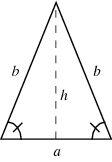
Technically, the secret of the accuracy in all swings - whether it is the full swing or the putter - is to be able to return to the Isosceles Triangle at the point of impact. This explains what I discovered and presented in my last post. Let us review what an isosceles triangle is.
Here is another fallacy I have been advocating before, "The technique follows the same intention as the full swing - use the big muscles for consistent accuracy." Well not entirely wrong in a way - this statement is correct when you think of the putt as two pieces. The first is the big muscles; the second is a rebound with the absence of the big muscles. Sounds confusing isn't it?
An isosceles triangle is a triangle with (at least) two equal sides. In the figure above, the two equal sides have length  and the remaining side has length
  . This property is equivalent to two angles of the triangle being equal. An isosceles triangle therefore has both two equal sides and two equal angles. The name derives from the Greek iso (same) and skelos (leg).
A triangle with all sides equal is called an equilateral triangle, and a triangle with no sides equal is called a scalene triangle. An equilateral triangle is therefore a special case of an isosceles triangle having not just two, but all three sides and angles equal. Another special case of an isosceles triangle is the isosceles right triangle.
For golf, let us not dwell on the other special isosceles triangle but just the one pictured above. Picture your shoulders as the side "a" and the sides "b" as the distance of both shoulders to the ball. On the upswing, the "b" sides will no longer be equal - the left getting longer and the right getting shorter. You can test this by facing both hands together and looking how the left hand gets shorter in relation to the right hand while moving the shoulders around and the arms moving up. What happens, technically speaking, is the face of the club or putter opens up. To get it back to the square position (the isosceles triangle), one has to let the shoulders wait for the hands to catch up at the point of impact.
Have you not noticed that when you really want to hammer the ball and let the body work more - the ball slices? Yes, that is the body not waiting for the arms (the other way around - hook - is possible but usually new golfers cannot do this). Now that you know the technical stuff, let us go to the practical side.
Here is another fallacy I have been advocating before, "The technique follows the same intention as the full swing - use the big muscles for consistent accuracy." Well not entirely wrong in a way - this statement is correct when you think of the putt as two pieces. The first is the big muscles; the second is a rebound with the absence of the big muscles. Sounds confusing isn't it?
- First, practice how hard you far you want the ball to go.
- When satisfied, lay down the club with the left hand roughly square to the target, both feet together.
- Start aiming the club to the target while the right hand joins in to fully grip the club.
- With both hands now on the club, finish the targeting of the putter face to the target.
- Once satisfied and while still looking at the target, move the feet apart for the proper stance.
- Start the back swing with shoulders up to the point you previously (first bullet) practiced.
- With the shoulders relaxing, let the putter bounce back with the arms guiding it back to the target.
- The isosceles triangle is achieved at point of impact - then becomes a scalene triangle again after impact. Note that the reverse scalene triangle happened at the upswing also.
Tuesday, October 24, 2006
Getting Really Technical
I just got back from a 5 day trip to Palm Coast, Florida. I played three golf games in three consecutive days. I took pictures of my friends' swings and ask them to take my picture too. After the game, while perusing my digital camera images, it became apparent that my finish form is not that good looking. My friend has a better looking form. That was the first day. Even though I was out driving my friend and out-scored him, I decided that his form will help me improve further.
The difference between my form and his is the finish of the swing. He turns his shoulders around and stays there even at the end of the swing while I seem to be standing up erect when I finish. On the second day, I decided to put that end of the swing form into mine. Disaster. I started pushing and fading my ball to the right. Although mostly serviceable, this was a night and day difference from the previous day where my ball is going straight to my target with a slight draw at times.
This effect made me to think and figure out why. There is a similarity to my putting - when I open my shoulders during the stroke, the ball goes right. The explanation is the face of the club or putter must be striking the ball with an open face. When you think about it, this is really what is happening. If you think of your shoulders as two points of a triangle and the third point is the club head, the distance of the shoulders to the club head must remain the same for both the time of set-up and the time of the hit. Opening the left shoulder makes the distance to the ball longer while the right shoulder's distance get shorter - the effect of which is an open club face. Vice-versa can happen too but seldom.
This said and proven, I reverted back to my old form and played happily ever after. By the way, this topic has a very important implication to putting. The face of the clock should be visualized, the shoulders turning like a pendulum, the force measured by the "hours" separating the backward and forward stroke - and all successfuly implemented to be able to putt straight.
The difference between my form and his is the finish of the swing. He turns his shoulders around and stays there even at the end of the swing while I seem to be standing up erect when I finish. On the second day, I decided to put that end of the swing form into mine. Disaster. I started pushing and fading my ball to the right. Although mostly serviceable, this was a night and day difference from the previous day where my ball is going straight to my target with a slight draw at times.
This effect made me to think and figure out why. There is a similarity to my putting - when I open my shoulders during the stroke, the ball goes right. The explanation is the face of the club or putter must be striking the ball with an open face. When you think about it, this is really what is happening. If you think of your shoulders as two points of a triangle and the third point is the club head, the distance of the shoulders to the club head must remain the same for both the time of set-up and the time of the hit. Opening the left shoulder makes the distance to the ball longer while the right shoulder's distance get shorter - the effect of which is an open club face. Vice-versa can happen too but seldom.
This said and proven, I reverted back to my old form and played happily ever after. By the way, this topic has a very important implication to putting. The face of the clock should be visualized, the shoulders turning like a pendulum, the force measured by the "hours" separating the backward and forward stroke - and all successfuly implemented to be able to putt straight.
Sunday, October 15, 2006
Putting
Putting is probably a very personal thing. It is so easy to do for everyone and you really need no skill to hammer a ball to the hole. This is the reason why no one will believe if I say follow this technique. What I will write here is my own, designed for me, works for me, and put in writing for me to remember.
The technique follows the same intention as the full swing - use the big muscles for consistent accuracy. It also use the grip techniques extensively. It is important to note the techniques employed here. It is like the grip I rated G-10. The right hand starts and then the focus is put on the left hand. The intent is to leave the right hand immobilized, the left hand in charge and the shoulder make the hit. Here is how I do mine.
Lay down the club with the right hand roughly square to the target. Now let the left hand cradle (literally cradle!) the club. The focus is still on the on the right hand until it is laying and sitted comfortably on the putter. Usually the right thumb should find itself on top of the flat spot of the putter grip. Now comes the finer aiming with the left hand. Once satisfied, the left hand pushes the putter head out and upwards (at around two o'clock) - the shoulder instinctively following. The forward motion is done with the turn of the shoulder.
Things to note: the big muscle is employed (shoulder); the cradle position of the left hand prevents fanning, same purpose for the full grip of the right resting on the putter grip. The last focus was on the left hand.
My major problems in putting are twofold: number one is my eyesight, I have a major case of astigmatism; second is my natural tendency to push the putter. Astigmatism is really bad because you see the ball where it is really not - your vision is distorted. I really on logical memory to sight the putter. Combine this with yips and it is disaster big time.
I am thinking of not fighting this and maybe working my handicap to my advantage. In order to do this, I will open my stance from now on. This thing works! Also, from now on, thinking the result is far more important than thinking shoulders, etc. This leaves everything to muscle memory, the ultimate golf skill! The putting procedure now should be:
All the above were written one year ago. It is amazing that when you find a golf secret, then you somehow also discover the key to somebody else's. Here is what I read about Lorena Ochoa how she won today the Samsung World Championship golf tournament.
"She got up this morning and went for a run and then was totally calm when she got to the golf course," said Dave Brooker, her caddie. The night before at the home of Tom and Kathy Mahoney and with the help of former Bel Air assistant pro Nick Bradley she worked on keeping her weight on her left leg during her putting stroke to avoid her tendency to lift her head back too soon and open the putter face.
Well I discovered the same thing in the past few days. My putts are going to the right because I do not stay still after I hit the ball, in effect, not following through. Another error is that I always imagine that the putter must stay square to the target when that is really impossible - it actually sends your ball to the right. If you try to push the ball to the target without a back stroke, you will know that you cannot do so with the putter face square. The putter face must close after hitting the ball - else it goes right.
The putting procedure now should be:
The technique follows the same intention as the full swing - use the big muscles for consistent accuracy. It also use the grip techniques extensively. It is important to note the techniques employed here. It is like the grip I rated G-10. The right hand starts and then the focus is put on the left hand. The intent is to leave the right hand immobilized, the left hand in charge and the shoulder make the hit. Here is how I do mine.
Lay down the club with the right hand roughly square to the target. Now let the left hand cradle (literally cradle!) the club. The focus is still on the on the right hand until it is laying and sitted comfortably on the putter. Usually the right thumb should find itself on top of the flat spot of the putter grip. Now comes the finer aiming with the left hand. Once satisfied, the left hand pushes the putter head out and upwards (at around two o'clock) - the shoulder instinctively following. The forward motion is done with the turn of the shoulder.
Things to note: the big muscle is employed (shoulder); the cradle position of the left hand prevents fanning, same purpose for the full grip of the right resting on the putter grip. The last focus was on the left hand.
My major problems in putting are twofold: number one is my eyesight, I have a major case of astigmatism; second is my natural tendency to push the putter. Astigmatism is really bad because you see the ball where it is really not - your vision is distorted. I really on logical memory to sight the putter. Combine this with yips and it is disaster big time.
I am thinking of not fighting this and maybe working my handicap to my advantage. In order to do this, I will open my stance from now on. This thing works! Also, from now on, thinking the result is far more important than thinking shoulders, etc. This leaves everything to muscle memory, the ultimate golf skill! The putting procedure now should be:
- Read the putt, decide on the break, and align the ball (with line) towards the target.
- Do several practice putts to get the feel for the length of the putt that is needed. Remember to the ball rolling there.
- With an open (including open shoulders), align the putter lines to the line on the ball, and repeat the same practice thought - move the ball to the target spot. Note that the shoulders should have taken over.
All the above were written one year ago. It is amazing that when you find a golf secret, then you somehow also discover the key to somebody else's. Here is what I read about Lorena Ochoa how she won today the Samsung World Championship golf tournament.
"She got up this morning and went for a run and then was totally calm when she got to the golf course," said Dave Brooker, her caddie. The night before at the home of Tom and Kathy Mahoney and with the help of former Bel Air assistant pro Nick Bradley she worked on keeping her weight on her left leg during her putting stroke to avoid her tendency to lift her head back too soon and open the putter face.
Well I discovered the same thing in the past few days. My putts are going to the right because I do not stay still after I hit the ball, in effect, not following through. Another error is that I always imagine that the putter must stay square to the target when that is really impossible - it actually sends your ball to the right. If you try to push the ball to the target without a back stroke, you will know that you cannot do so with the putter face square. The putter face must close after hitting the ball - else it goes right.
The putting procedure now should be:
- Read the putt, decide on the break.
- Do several practice putts to get the feel for the length of the putt that is needed. Remember to think the ball rolling there.
- Hold the putter with the left hand and aim.
- Try (only) to keep the shoulders and feet parallel to the target line.
- Bring the putter back with the left shoulder.
- Bring the putter forward with the left shoulder and instinctively letting the putter close after impact.
- Do not look for the ball - keep the eyes rooted to where the ball was at impact.
- Observe how the putter face naturally closes on the follow through.
Thursday, September 28, 2006
Divots
It is fortunate for the rich golfer who started in a country club. Here they started and practiced their golf swing on real turf. With them, they must have mimicked what they see on TV, the divots flying after every shot. Divots to them become second nature - their muscles always anticipating that dig-into-ground feeling.
Pity us poor golfers. We bought our first golf set from the "SALE" rack and can only practice the swing on a piece of carpet inside the bedroom. We even have to use the shortest club and purposely flatten the swing to avoid hitting the ceiling of the bedroom. Worse is we learned to instinctively jerked up the left shoulder after hitting the plastic ball lest we ruin our floor. It is not unusual that the Missus to find scratches on the floor and ceiling. On my case you can even find a hole in my dropped ceiling caused by the rubber trainer that is not suppose to fly out of the head of the club. I still wonder where that rubber trainer went when it created that hole. After thirty years + years, it has to be still in there.
Well it is time for me to learn to make a divot. I am still not a member of a country club so I cannot learn it from real turf. I must learn it on artificial turf in the driving range - I can afford that now... How do I do it, that is the question.
Pity us poor golfers. We bought our first golf set from the "SALE" rack and can only practice the swing on a piece of carpet inside the bedroom. We even have to use the shortest club and purposely flatten the swing to avoid hitting the ceiling of the bedroom. Worse is we learned to instinctively jerked up the left shoulder after hitting the plastic ball lest we ruin our floor. It is not unusual that the Missus to find scratches on the floor and ceiling. On my case you can even find a hole in my dropped ceiling caused by the rubber trainer that is not suppose to fly out of the head of the club. I still wonder where that rubber trainer went when it created that hole. After thirty years + years, it has to be still in there.
Well it is time for me to learn to make a divot. I am still not a member of a country club so I cannot learn it from real turf. I must learn it on artificial turf in the driving range - I can afford that now... How do I do it, that is the question.
Wednesday, September 27, 2006
Swing Check Points - the New Testament
Check points for a total body swing:
- Club set-up:
- The left hand holds the club while aiming to the target. The right hand then grips the club. Purpose: To ensure that one does not open up the shoulders while aiming.
- The shaft points to the left shoulder and aligned with the left arm which makes the right shoulder droop lower than the left shoulder. Purpose: This simulates the clubface allignment at the moment of impact.
- The arms are purposely held hanging straight down towards the ground, thereby, accentuating the drooping of the right shoulder plus there is a noticeable right angle created between the club and the arms. Purpose: The arms are hanged straight down and the club held almost at a right angle (almost cocked already) to promote the automatic cocking of the club. Like mentioned in the PLANE - cocking by the right hand along the plane should never be employed.
- Grip: The interlocked fingers are more in. The palms are facing each other where the left hand you may think is weak and the right hand may think is strong. The hands are felt as a one solid mass. The V of the right hand is felt more - to make the cocking easier and automatic. Purpose: Not too sure - ensures against fanning the clubface at the same time having a stronger grip? Or, maybe the grip works better with the chin-to-chin technique?
- Stiff right knee: The relative position of the right knee stays at right angle to the target line at all times during the backswing. Purpose: The same as the next one - accuracy and power.
- Flat foot stance: Ensure that both feet are planted on the ground securely. The left sole and heel only lifts up when pulled by the upper body, else it stays down. Purpose: To ensure that the club comes back consistently.
- Plane: DO NOT USE WHATSOEVER. Purpose: Shanks can easily happen when visualizing of the plane. Just stick to the chin-to-chin technique. However, although it is not conciously employed with this technique, the roundhouse swing of the shoulders functions the same way.
- Chin-to-chin: The left shoulder pushes the whole club away into a roundhouse motion until the left shoulder hits the chin. Then the roundhouse motion is brought down, around and through the ball - without stopping until the right shoulder hits the chin. Purpose: to make a complete pendulum swing for power and consistency.
Thursday, August 31, 2006
Swing Check Points - In the beginning...
- The flail, the flail.
- Club set-up: The club shaft points to the left shoulder and aligned with the left arm. Purpose: This simulates the clubface allignment at the moment of impact
- Grip: The thumb and foreginger pinches the shaft "actively" with the feeling that the club is to be taken initially by the hands toward the two o'clock position and eventually along the swing plane until the upper body is flexed. Purpose: To ensure that the hands start the swing and the clubface is not fanned open.
- Plane: The hands points at the bottom of the plane and takes the club head toward the two o'clock position and along the plane. Purpose: For fine targeting and accuracy.
- The left shoulder pushes the clubface along the target line at the start of the swing. Purpose: For accuracy - the proof is in the putt (use left shoulder also to bring the putter back).
- Coiled Upper Body - Upswing: The hands and arms bring the club up until the upper body is coiled to the maximum. Purpose: To make sure that shoulders are fully coiled and the power transferred to the upper body. This is the upswing of the flail technique so "feel" the flail with the left shoulder!
- Flat foot stance: Ensure that both feet are planted on the ground securely. The left sole and heel only lifts up when pulled by the upper body, else it stays down. Purpose: To ensure that the club comes back correctly and to maximize coiling of the upper body - for power.
- Stiff right knee: The relative position of the right knee stays at right angle to the target line at all times during the backswing. Purpose: The saem as no. 5 - accuracy and power.
- Coiled upper body - Downswing: Once the hands and arms have coiled the upper body, an entwined power is felt, and that coiled feeling is the one that hits the ball. Purpose: Delayed hit. This is the flail hitting the ball so "feel" the failing done by the left shoulder.
- Reverse C: The coiled feeling is imagined as going around and through the ball - which imparts more power. The right shoulder is way in front of the left shoulder at the finish position. Purpose: P-O-W-E-R.
Monday, August 21, 2006
Flat Footed Golfer?
With the golfer image that we always see on TV, we tend to imitate it so closely that we tend to pose like a golfer. One of the things I am sure I am guilty of is raising the left foot because that is how the pros look at the top of their swing - the left heel raised. But have we stopped and thought about how the pros got to that position? I "pose" to that position but the pros' left heel was pulled to that position - the difference is that they have the muscle tension but mine is just for show - no valid tension (in golf parlance) at all.
Maybe, for the neophytes in golf like me, we should just stay flat-footed on our backswing and let the tension happen by itself. As matter of fact, this flat-foot rule can be elevatedt to the same stutus as the rigid-right knee rule. Let us try this out for now.
Maybe, for the neophytes in golf like me, we should just stay flat-footed on our backswing and let the tension happen by itself. As matter of fact, this flat-foot rule can be elevatedt to the same stutus as the rigid-right knee rule. Let us try this out for now.
Friday, August 18, 2006
Practicing the Shoulders Swing
You know that finshing your backswing is integral to hitting good shots. Yet pressure and impatience make it one of the first fundamentals you forget (the real problem is time - you tend to forget over time - in weeks - and the shoulders get lazy and the arms take over). First your backswing gets short, then your transition gets quick, and suddenly solid contact is elusive (and you start shanking!). This creates a nasty cycle: the more your ball striking deteriorates, the more you shorten and quicken your swing to compensate.
When something goes wrong, check your full backswing first. Your entire swing should feel long and slow, powerful but almost effortless. To make sure the backswing does't get short, Freddie Couples practices hitting shots without it. Instead of addressing the ball, start at the top of the swing, hold it for a few seconds, and then swing through. Hitting a few dozen balls this way not only helps your body get more comfortable with a full backswing position, it's a good way to work on your downswing timing and hand-eye coordination.
When something goes wrong, check your full backswing first. Your entire swing should feel long and slow, powerful but almost effortless. To make sure the backswing does't get short, Freddie Couples practices hitting shots without it. Instead of addressing the ball, start at the top of the swing, hold it for a few seconds, and then swing through. Hitting a few dozen balls this way not only helps your body get more comfortable with a full backswing position, it's a good way to work on your downswing timing and hand-eye coordination.
Friday, August 11, 2006
The Shoulders Swing
Now is the time to visualize the golf swing as hitting the ball with the shoulders - all the other parts purposely ignored. After several practices, I realized that this really works. And in the process, I learned quite a few other things. WORD OF CAUTION - DO NOT FORGET THAT THE MAIN INTENT IS TO MENTALLY THINK OF THE SWING AS A SHOULDER SWING - the arms and hands just automatically executes by centrifugal force. At the same time, the small wheel and the big wheel concept must be employed.
Here is how to do it:
Please do not be fooled that this section may not be important. At the moment, I would say this is the most important section that I have written.
The locked knee is a crucial part of it for it maintains the body's alignment to the target. The shoulders pivots around the knee - as far as it will go. This mental change, that is, having the focus on the weight of the upper torso while swinging is very, very important.
AGAIN, AFTER SETTING UP WITH THE DOMINANT LEFT HAND, THE SHOULDERS PUSHES THE CLUBHEAD ALONG THE DESIRED PATH TO THE TOP (COCKING OF THE CLUB). THEN THE SHOULDERS PULL DOWN AUTOMATICALLY TO THE BALL WITH THE LEFT ARM GUIDING DOMINANTLY THE CLUBHEAD TO THE BALL AND THEN AROUND TO A C FINISH.
THIS IS REALLY A VERY SIMPLE MOVE AND LEAVES YOU WITH THE FEELING THAT YOU EXECUTED TIGER'S SWING. IT IS CONSISTENTLY ACCURATE ALSO.
Here is how to do it:
- Standard setup for targeting purposes - feet, shoulders aligned. However, the club is resting fully alined with the left arm - to the point that the hands rest to the right of the head (vs. directly below).
- The small wheel in motion: Feel the right thumb and forefinger wrap and resting on the club. Feel the right palm comfortably sitting on the left hand. Right fingers are not jammed towards the left fingers - it is gripping comfortably the club. The right hand will actively lift the club like a hammer towards the plane of the big wheel (Hogan's plane).
- Be consciously aware of the knee-locked right leg.
- Firm up the left arm and hand.
- Shoulders is push towards the ball and bring the club head along the path it will take on the downswing making sure that the (small wheel) right hand cocks the club shaft fully along the (now merged small wheel, big wheel) plane.
- Pivot the shoulders around the right locked leg until the left muscles is pulled all the way. Of course, for half or partial swings - it is not necessary to go all the way
- Again, make sure that the right hand fully cock the club shaft along the plane at the top (small wheel).
- The shoulders make the hit by moving the weight and turning towards the ball.
- The weight movement should automatically force a reverse C finish.
Please do not be fooled that this section may not be important. At the moment, I would say this is the most important section that I have written.
The locked knee is a crucial part of it for it maintains the body's alignment to the target. The shoulders pivots around the knee - as far as it will go. This mental change, that is, having the focus on the weight of the upper torso while swinging is very, very important.
AGAIN, AFTER SETTING UP WITH THE DOMINANT LEFT HAND, THE SHOULDERS PUSHES THE CLUBHEAD ALONG THE DESIRED PATH TO THE TOP (COCKING OF THE CLUB). THEN THE SHOULDERS PULL DOWN AUTOMATICALLY TO THE BALL WITH THE LEFT ARM GUIDING DOMINANTLY THE CLUBHEAD TO THE BALL AND THEN AROUND TO A C FINISH.
THIS IS REALLY A VERY SIMPLE MOVE AND LEAVES YOU WITH THE FEELING THAT YOU EXECUTED TIGER'S SWING. IT IS CONSISTENTLY ACCURATE ALSO.
Thursday, August 10, 2006
Together at Last, Small Wheel, Big Wheel and Shoulders' Swing
The small wheel and big wheel concept is only the beginning. It is an integral part of learning the full swing but they are just parts of the real swing. They must be melded together to produce the correct full swing. But let this be a warning to all, the small wheel concept must never be forgotten. As a matter of fact, it should be always be a part of the warm up routine - to let the hands know that they are suppose to take an active part in hitting the ball. But why don't I have a warning for the big wheel? Because the small wheel becomes a part of the big wheel and the big wheel becomes the full and correct swing. It becomes the correct swing only when the big wheel incorporates the essence of the small wheel. When both are employed with the shoulders make the hit (see the Shoulders Swing section), then you got the correct swing mechanics.
Let me repeat. The cocking of the right wrist is the center of the small wheel. The cocked wrists hits the ball like a hammer. The big wheel is the like the Hogan plane. It is the wheel where the neck is the center and the shoulders (particularly the left shoulder) acts as the prominent trigger that do the backswing and the forward swing.
The objective of the left shoulder is to push towards the ball and turn the body pulling the left side muscles as much as possible. In the process, the right hand ensures that the small wheel becomes melded to the plane (of the big wheel) by making sure the wrists cocks fully with its plane melded to the plane of the big wheel. While the left shoulders is twisting the body, the eyes are sensing and making sure that the club is set fully by the right hand at the correct slot (along the plane). When this is done fully, then the shoulders start the untwisting motion (downswing) to hit the ball automatically.
This section takes too much for granted. Details should gotten by reading again the section of the wheels and the shoulders swing sections.
Let me repeat. The cocking of the right wrist is the center of the small wheel. The cocked wrists hits the ball like a hammer. The big wheel is the like the Hogan plane. It is the wheel where the neck is the center and the shoulders (particularly the left shoulder) acts as the prominent trigger that do the backswing and the forward swing.
The objective of the left shoulder is to push towards the ball and turn the body pulling the left side muscles as much as possible. In the process, the right hand ensures that the small wheel becomes melded to the plane (of the big wheel) by making sure the wrists cocks fully with its plane melded to the plane of the big wheel. While the left shoulders is twisting the body, the eyes are sensing and making sure that the club is set fully by the right hand at the correct slot (along the plane). When this is done fully, then the shoulders start the untwisting motion (downswing) to hit the ball automatically.
This section takes too much for granted. Details should gotten by reading again the section of the wheels and the shoulders swing sections.
Tuesday, August 01, 2006
Big wheel, small wheel
Here is what I learned while studying the Carlos Franco's (see previous posting) chipping technique. The chipping swing must consists of two wheels, the big and the small wheel. The attention is on the small wheel and this is the one that imparts the back spin. I never thought about a two wheeler swing before - I wonder what this will do to a full swing?
What will further testing show? A lot! First, it revealed the techical explanation on how professionals can put a spin on the ball to be able to back it up. Second, and foremost, I realized that I am missing this in my swing techniques.
Chipping I think is the best way to show how to do this technique. Let us learn how to lob a ball. On the address position, keep the clubface open. Break your wrist backward, yes backward. Now slide the clubface under the ball with the left hand. See the difference?
Now let us go incorporate this "back-hand" with all our swing, including putting. Let us see what happens. I think this will add distance to my game...
This is the way to play the normal golf swing using this technique:
What will further testing show? A lot! First, it revealed the techical explanation on how professionals can put a spin on the ball to be able to back it up. Second, and foremost, I realized that I am missing this in my swing techniques.
Chipping I think is the best way to show how to do this technique. Let us learn how to lob a ball. On the address position, keep the clubface open. Break your wrist backward, yes backward. Now slide the clubface under the ball with the left hand. See the difference?
Now let us go incorporate this "back-hand" with all our swing, including putting. Let us see what happens. I think this will add distance to my game...
This is the way to play the normal golf swing using this technique:
- On the setup, make sure that the position of the arms, hands and club shaft is almost straight and it is in the hitting position at the moment of impact. If this is followed correctly, the hands will appear a little left of the chin position.
- Start the swing by starting the small wheel. This is done by breaking the right wrist backward toward the two o'clock position. The feeling is also the motion goes in the direction of where the thumb and forefinger presses together - which I should remember easier than describing it.
- The small wheel will start the rolling of the big wheel and will end only when the feeling of tightness is encountered.
- The start of the foreward swing is the automatic rebound of the bound muscles. The body shifts the weight to the left.
- The hit is automatically done by the hands when the body and the arms are already at the hitting zone - all the power on the left leg already.
Thursday, July 13, 2006
Lob Chip to Putting to Hammer
The title of this section is not indicative of its importance in the total realm of the golf swing. You must consider the mechanics employed here as the same mechanics for the full swing. Having said that, let us start.
The lob chip is so difficult to execute that if the mechanics are not recognized correctly, it cannot be done consistently accurate. The main secret is the grip, which the hub of the little swing (vs. neck for full swing), and the direction of the break of the right wrist.
Let us talk about the hub of the chip (or putting). If the neck will sway or bob while you are executing your full swing, you will never hit a straight shot consistently. You may even entirely whif the ball. That is the very reason why all golf instructions emphasizes the stillness of the head on the golf swing. Now, bring the concept to the chip and putting. You cannot make the hub of both these little movements be the neck also, should you? I know this goes contrary to what I have been saying from the very start but this revelation only got started because of what I learned from Carlos France (see GHO section).
With the chip and putting, the golf plane is really a small wheel with the hub as the clasp hands. The object of that little swing is keep that hub or the hands very still. Of course, not to the point of restricting the movement.
If you do this, you will notice that to move the club head or putter head away from the ball, you naturally will have to break your wrist backward. Upon a lot of repetitions of this movement- the breaking of the wrist and while keeping the hands almost dangling over the ball - you will notice that the effective and consistent flip of the right wrist is like a small cocking (as in full swing) which effective moves the right clasp hands throwing the club to the 2:00 o'clock position (hey, this was mentioned in the full swing way back in some chapters of this blog!).
Now, here is the important effect of this method in putting: You do not have to control the direction of the backswing and forward motion of the putter - it is automatic. The only thing you have to worry about is the direction and the distance. Again, this is the secret to putting. If you noticed in the other chapter, I referred to this as Tiger's secret. At that time, I was not able to really comprehend why it was working (sometimes). It was really keeping the center of the little swing or plane as immobile as possible.
Here is the putting mechanics that work for me now. Remember the object is to keep the hub as close as possible where it started - dangling under your chin.
Watch out, you may cry out of joy! This will make you a very accurate putter. Ten footers will be nothing after this. The chip is executed the same way.
The lob chip is so difficult to execute that if the mechanics are not recognized correctly, it cannot be done consistently accurate. The main secret is the grip, which the hub of the little swing (vs. neck for full swing), and the direction of the break of the right wrist.
Let us talk about the hub of the chip (or putting). If the neck will sway or bob while you are executing your full swing, you will never hit a straight shot consistently. You may even entirely whif the ball. That is the very reason why all golf instructions emphasizes the stillness of the head on the golf swing. Now, bring the concept to the chip and putting. You cannot make the hub of both these little movements be the neck also, should you? I know this goes contrary to what I have been saying from the very start but this revelation only got started because of what I learned from Carlos France (see GHO section).
With the chip and putting, the golf plane is really a small wheel with the hub as the clasp hands. The object of that little swing is keep that hub or the hands very still. Of course, not to the point of restricting the movement.
If you do this, you will notice that to move the club head or putter head away from the ball, you naturally will have to break your wrist backward. Upon a lot of repetitions of this movement- the breaking of the wrist and while keeping the hands almost dangling over the ball - you will notice that the effective and consistent flip of the right wrist is like a small cocking (as in full swing) which effective moves the right clasp hands throwing the club to the 2:00 o'clock position (hey, this was mentioned in the full swing way back in some chapters of this blog!).
Now, here is the important effect of this method in putting: You do not have to control the direction of the backswing and forward motion of the putter - it is automatic. The only thing you have to worry about is the direction and the distance. Again, this is the secret to putting. If you noticed in the other chapter, I referred to this as Tiger's secret. At that time, I was not able to really comprehend why it was working (sometimes). It was really keeping the center of the little swing or plane as immobile as possible.
Here is the putting mechanics that work for me now. Remember the object is to keep the hub as close as possible where it started - dangling under your chin.
- At address (which is very open for me), align the club perpendicular to the line of target.
- The right thumb must rest on top of the flat portion of the grip and must be welded tightly together with the forefinger.
- Break the right wrist backwards, like hammering a nail, towards the 2:00 o'clock position or towards the center of the bound two fingers above. In other words, towards where it will normally break if you are hammering a nail.
- While executing the above, make sure that the clasped hands (hub or center) stay as much as possible to the same spot, intentionally making that perimeter (club head) of the little circle (plane) as small as possible.
- The downswing is done by the left hands.
- After the ball, ensure a smooth follow through without regard to the hub any longer.
Watch out, you may cry out of joy! This will make you a very accurate putter. Ten footers will be nothing after this. The chip is executed the same way.
Subscribe to:
Posts (Atom)